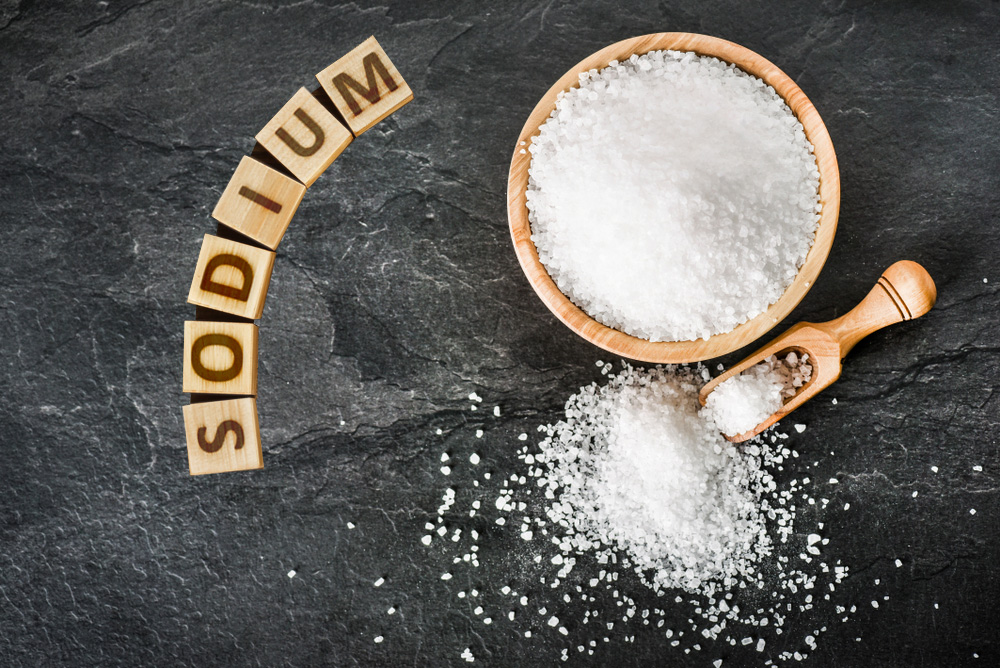
Sodium is a mineral very present in the human body, especially in plasma. It is supplied by food in the form of sodium chloride (salt). Excesses are a cause of risk for high blood pressure. So what are the functions of this mineral salt, its nutritional requirements, and the risks of deficiency or overdose?
What exactly is sodium?
Sodium, under its chemical symbol Na, which appears in the periodic table of elements, is a mineral salt. In the body, it is found in the blood and the liquid.
What are the functions of sodium?
- Sodium is necessary for the transition of nerve impulses and for muscle contraction.
- Its concentration in the blood and the interstitial fluid determines the amount of water in the cells and the volume in the blood.
- For people who are sensitive to salt intake, overdosing on sodium can increase blood volume and thus increase the occurrence of high blood pressure
How much sodium should be consumed?
For a sufficient amount to meet the body's basic needs, 1 to 2g of salt (400 to 800 mg of sodium) is needed
In order to prevent high blood pressure and the resulting cardiovascular disease, several health safety agencies have recommended a maximum intake that should not be exceeded, as intakes are high in France and in many other countries.
For adults, the French Food Safety Agency (Afssa) recommended a maximum intake of 8g of salt (3200mg of sodium) per day in 2000.
Over the past 15 years, several studies have shown the consequences of salt overdose on cardiovascular risk and proposed other deleterious effects, such as an increased risk of stomach cancer or osteo-posis (bone demineralisation).
For example, the conclusion of some 30 intervention studies is that, on average, a reduction of 1. 7 to 1. 8g of salt per day helps normotensive people (normal blood pressure) to lower their systolic pressure (the first digit of blood pressure) by 0. 2 and their diastolic pressure (the second digit) by 0. 1; while hypertensive people experience a decrease of 0. 5 and 0. 3.
Specialists have evaluated the consequences of salt on cardiovascular diseases, and have taken the statistics from 19 studies on more than 177,000 individuals and found a 23% reduction in strokes and a 17% reduction in myocardial infarctions for a salt consumption of 5g instead of 10g per day.
Since 2011, the third National Nutrition and Health Programme has lowered the recommendations for France to a maximum of 8g of salt per day for men, and 6. 5g of salt for women and children.
The European Food Safety Authority (EFSA) in turn recommends a maximum intake of 6g of salt (2400mg of sodium) per day, while the World Health Organisation (WHO) sets a target of 5g of salt (2000mg of sodium) maximum.
In addition to dietary intake, it is suggested that during activities lasting more than one hour, a drink with 1. 2g of salt per litre is consumed.
Sportsmen and women have an important need for sodium, due to losses in sweat which can reach 6 to 7g of salt in 1 to 3 hours of activity, especially during intense training and high temperatures.
According to PURE research released in 2014, a salt intake of less than 3g per day is detrimental to health, creates the risk of mortality and paradoxically cardiovascular mortality.
What foods are high in sodium?
Foods rich in sodium are those that have been salted during their preparation, in a way that favours their preservation or flavour: cold meats, sauces, semi-preserves, cheeses, etc. Fruits, vegetables, milk, yoghurts, meat, fish, eggs, contain little sodium.
The first three foods that contain the most sodium per 100g are: salt with 39100 mg, dehydrated vegetable broth with 13200 mg, and soy sauce with 6260 mg of sodium. According to consumer studies, salt added during cooking or at the table is equal to 20% of the sodium intake of the French.
Most of this comes from foods that have already been salted during their manufacture, such as bread, rusks, cold meats, ready-made meals, cheeses, soups and broths, pizzas and savoury pies.
Balancing your sodium intake therefore means limiting the consumption of industrial foods and cooking at home as much as possible with good salt.
Example: if a person takes 160g of traditional baguette with 30g of camembert plus 50g of white ham and 2g of salt to salt the dishes, he will get a total of 6g of salt.
What happens if you have too much or too little sodium?
Sodium underdose
Deficiency can occur in cases of severe chronic diarrhoea or a very limited salt-free diet. It is present in sportsmen and women, who do not replace the important losses in sweat. It leads to an alteration in the functioning of the nervous system, muscular weakness, hypotension and dehydration.
It can cause intolerance to iodine products and some anti-inflammatory drugs. Especially in the elderly, it suppresses appetite and can lead to undernutrition.
According to recent research, a salt intake of less than 3g per day increases the risk of mortality from several causes and from cardiovascular diseases. Studies in 1990 already predicted this unexpected effect.
Excess sodium
Salt overdose is a factor in the development of high blood pressure and cardiovascular disease. However, men do not react to salt in the same way. Those with the highest intakes are: people with high blood pressure, diabetics or overweight people, the elderly, and black people of African origin (for genetic reasons).
The National Cancer Institute (Inca) recommends moderating salt intake to 6g per day, as overdosing on salt and salty foods increases the risk of stomach cancer. Overdosage of salt weakens the gastric mucosa and is thought to increase infection with Helicobacter pylori, the germ responsible for stomach ulcers.
Overdosage of salt promotes urinary calcium elimination and could lead to the formation of calcium-based kidney stones. Its role in promoting osteoporosis is predictable, but not yet proven.
Note
- The elements that favour the assimilation of sodium are glucose and amino acids.
- Overdosage of salt in foods or drugs that contain high levels of sodium may reduce the effectiveness of lithium by increasing its renal excretion.
Conclusion
In conclusion, sodium is an important element, it regulates the distribution of water, especially in sportsmen and women, it is preferable to adapt the diet in this sense, especially during intensive activities to avoid cramps and muscle disorders.
It is also important to take into account that water in the body will move from the environment where there is the most sodium to the environment with the least sodium, this phenomenon is called osmosis.