
Chromium is one of the trace elements, which is not among the fundamental trace elements but still contains several properties. Like minerals, trace elements are essential for the proper functioning of the body.
What exactly is the role of this trace element and what are its recommended nutritional intakes, as well as the risks of deficiency or excess?
What exactly is chromium?
Chromium, with the chemical symbol Cr, which is present in the periodic table of elements, is a trace element. The benefits it brings to the human body are not really defined. It is present in several chemical forms: trivalent chromium (Cr3+) which is the best known in foodstuffs
What are the roles of chromium in the body?
- Chromium plays an important role in the action of insulin, a hormone that regulates blood sugar levels.
- It is also considered in the metabolism of carbohydrates, more precisely sugars, lipids which are fats and proteins.
Its functionalities are not yet perfectly defined, research is ongoing.
What are the nutritional contributions that chromium can make to the body?
Taking into account the lack of scientific data on chromium, there are still no conclusive results on its nutritional value.
The nutritional references published in France in 2000 are as follows:
- for a child aged 1 to 3 years the requirement is 25 micrograms of chromium per day,
- for a child aged 4 to 6 this rises to 35 micrograms,
- for a child aged 7 to 9 years 40 micrograms,
- for a child of 10 to 12 years it will be 45 micrograms,
- for a teenager from 13 to 19 years the requirement is 50 micrograms,
- for a woman under 55 years of age and pregnant women it is 55 micrograms,
- for a man under 65 it is 65 micrograms,
- for adult women over 55 and pregnant women it is 60 micrograms per day
- and finally for men over 65 the requirement is 70 micrograms per day.
In addition, specialists from the French Food Safety Agency (Afssa) have shown that it would be difficult to make up for these intakes and that the above figures should be revised, in order to arrive at a convincing result.
Around the year 2001, specialists from the North American Institute of Medicine (IOM) set limits for "adequate intakes" based on continuous intakes in several healthy populations.
These recommendations are of the order of half the French population.
For children aged 1 to 3 their bodies need 11 micrograms of chromium per day, for a child aged 4 to 8 they need 15 micrograms,
for a granddaughter aged 9 to 13 they need 21 micrograms while for an adult boy and woman under 50 it is 25 micrograms,
for a teenager aged 14 to 18 this rises to 24 micrograms, for a teenager between 14 and 18 and men under 50 their need is 35 micrograms,
for an adult woman over 50 the need is 20 micrograms,
for an adult man over 50 as well as pregnant women the need is 30 micrograms and;
for nursing women it is 40 micrograms per day.
Around 2014, the European Food Safety Authority (EFSA) stated that it did not have adequate studies to confirm the need for chromium and that it was not in a position to limit the nutritional references.
What foods contain the most chromium?
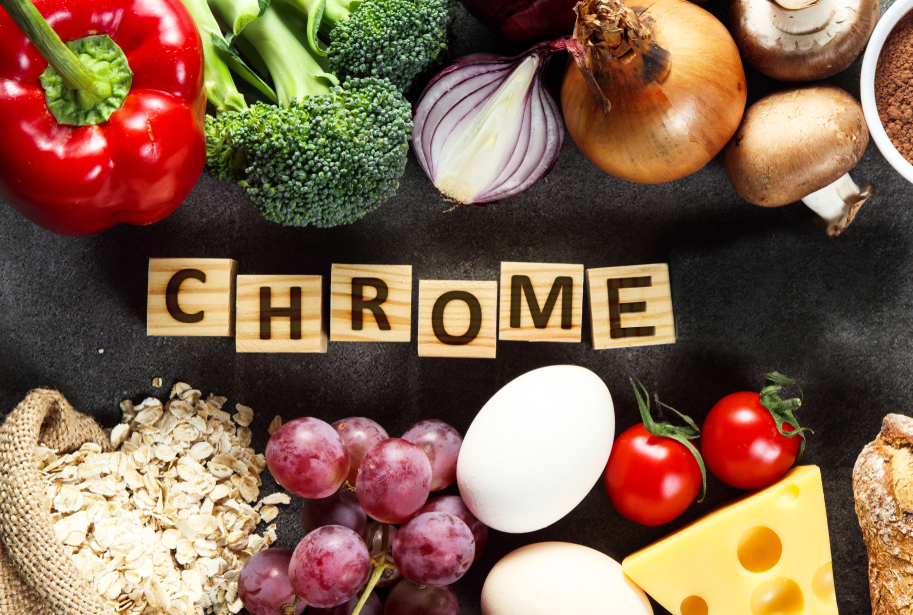
Chromium is quite rare in almost all foods, either in very small amounts. Animal livers, eggs, beef, wholegrain products, potatoes, and some fruits and vegetables have a slightly higher chromium content.
The 5 foods that are classified as having the highest chromium content for a quantity of 100g of food are: firstly dried garlic with a content of 60 micrograms in 100g, then broccoli with 18. 3 micrograms, then wholemeal muffins with 8 micrograms, then grape juice with 3.
3 micrograms, and finally beef with 2. 4 micrograms of chromium It should be noted that there are other foods of animal or vegetable origin or even beverages that contain chromium, but those mentioned above are the ones that contain the most.
What are the risks of chromium deficiency or overdose?
Risks of underdosing?
Some cases of loss, associated with a very low amount of chromium in the blood, have been detected in sick people, fed exclusively and durably by parenteral route (by infusion). The latter favoured manifestations of diabetes: very high blood sugar levels, glucose (sugar) in the urine, weight loss, as well as neurological disorders. In some patients, the symptoms disappeared after chromium supplementation.
Specialists do not have the necessary data to affirm that these symptoms were solely attributable to a loss of chromium, especially since the level of this trace element in the blood does not necessarily show the body's reserves.
Risks in case of overdose
According to the experts, they concluded that a high intake of chromium, up to 1000 micrograms per day in the field of supplementation studies, did not cause any adverse effects.
Neither Afssa (Agence française de sécurité sanitaire de l'alimentation), nor Efsa (European Food Safety Authority), nor the IOM (Institute of Medicine) have been able to set a safety limit for this trace element.
Note
- Chromium intake is high in the presence of vitamin B3 in foods of animal origin (in meat, fish) or vitamin C (in fruit and vegetables).
- Phytates (found in whole grain foods) may decrease chromium uptake.
To conclude
In conclusion, chromium is a trace element that helps the body to regulate the carbohydrates secreted by the pancreas, it is thus involved in the metabolism of carbohydrates (sugar) it also helps in the action of insulin (to regulate blood sugar levels), to calibrate the arrival of sugar from food in the blood or to promote lean body mass at the expense of fat.