Copper is a trace element necessary for several enzymes. It is mainly involved in the maintenance of cartilage and bones. It is also necessary to protect against infections and for a good heart function.
It is also recommended in cases of arthritis. Just like minerals, trace elements are essential for the proper functioning of the body. What are the roles, sources, effects in case of copper deficiency or excess?
What is copper?
Copper, with the symbol Cu in the periodic table of elements, is one of the essential trace elements. It is present in the human body in small quantities, 100 mg in an adult.
What are the roles of copper in the human body?
-
Multitudes of enzymes need copper to act effectively. For example, in
the functioning of several nutrients such as carbohydrates or sugars,
lipids or fats but also iron.
- It is involved in the synthesis of red blood cells, immune protection, bone mineralisation, the balancing of neurotransmitters and the production of melanin, the pigment that protects the skin from the sun.
- Copper is also an antioxidant, a factor in superoxide dismutase which is an important enzyme for protection against severe oxidation.
What are the recommended daily allowances?
Depending on age, the body's copper requirements vary.
- For children from 6 months to 12 months: the reference is 0. 6 mg per day
- For children aged 1 year to 3 years: the reference is 0. 75 mg per day
- For children aged 4 years to 0 6 years: the reference is 1. 0 mg per day
- For children aged 7 to 10 years: the reference is 1. 2 mg per day
- For adolescents aged 11 to 20 years: the reference is 1. 5 mg per day
- For women: the reference is 1. 0 mg per day
- For men: the reference is 1. 3 mg per day
- For pregnant or breastfeeding women: the reference is 2. 0 mg per day
- For sportsmen and women, the daily copper requirement should be increased by 0. 5 to 1 mg, due to sweat losses during heavy physical effort.
In which foods is copper found?
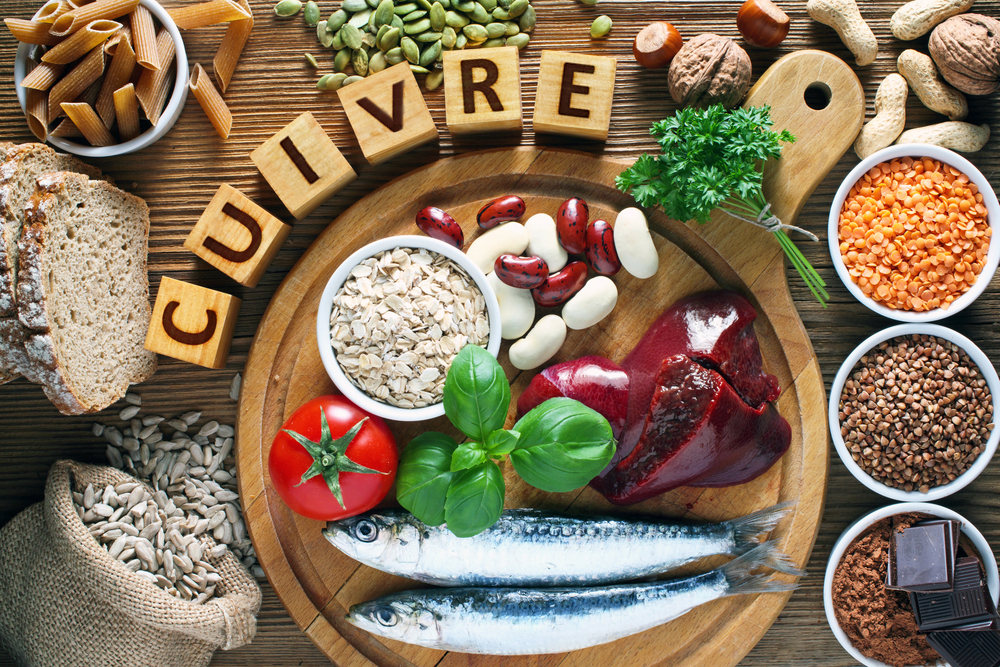
Copper is present in all foods, but it is most abundant in offal such as liver, seafood, nuts and also in cocoa. It is also present in poultry, pulses and wholegrain cereals. Brewer's yeast also provides a significant amount of copper.
In ascending order, the foods with the lowest to highest copper content are:
|
Food |
Average copper intake per 100g |
|
Wholemeal bread |
0,17 |
|
Cooked white bean, kidney bean, chickpea or lentil |
0,25 |
|
Cooked turkey |
0,3 |
|
Cooked wheat |
0,3 |
|
Müesli |
0,4 |
|
Cooked ham |
0,4 |
|
Button mushroom, avocado |
0,5 |
|
Roasted chestnut |
0,5 |
|
Goat's manure |
0,7 |
|
Cooked pink shrimp |
0,8 |
|
Almond, pistachio, walnut, pecan |
1,1 |
|
Cooked whelk |
1,3 |
|
Dark chocolate 70% cocoa |
1,4 |
|
Cooked crab or edible cake, raw oyster |
1,5 |
|
Hazelnut |
1,6 |
|
Cooked winkle |
1,7 |
|
Cashew, Brazil nut |
1,8 |
|
Unsweetened cocoa powder Unsweetened cocoa powder |
2,7 |
|
Cooked heifer liver |
3,5 |
|
Brewer's yeast |
5,3 |
|
Cooked lamb liver |
8,5 |
|
Cooked veal liver |
20,1 |
As an indication, 100 g of shrimp + 100 g of avocado, i. e. about one small avocado + 100 g of cooked lentils, about 3 heaped tablespoons give 100% of the recommended intake for an adult woman.
What are the risks of copper deficiency or overdose?
What are the risks of a lack of copper in the body?
Copper deficiency is rare. In babies, Meknes disease deprives all tissues of copper because it is a genetic disease linked to a deficiency in the proteins that transport copper.
The first symptoms are abnormal, sparse and dull hair. Then, they appear in the form of a delay in growth and development, digestive problems, muscular weakness and convulsions.
In adults, this deficiency is recognised by weight loss and early osteoporosis. Following obesity surgery, the simultaneous lack of copper, vitamins B6 and B12 causes neurological disorders.
The most frequent deficiency can be observed either in babies born prematurely, since the bulk of the copper reserves of the foetus are built up during the last trimester of pregnancy, or in adults suffering from recurrent diarrhoea.
Deficiency disrupts the renewal of red blood cells and affects the immune system. It can increase the risk of having a cardiovascular accident.
What are the risks of having too much copper in the body?
Excess copper leads to hepatitis, a liver disease, and is most often accompanied by jaundice.
This excess is visible in certain countries, either by adding copper to water for domestic use, for example in France, the level of copper in tap water is limited to 2 mg per litre, or via kitchen utensils such as pots when cooking food, also known as "Indian cirrhosis". It can also be linked to an abuse of trace element supplementation.
According to Wilson's disease, copper accumulates in the human body as a result of a genetic abnormality, which prevents its normal elimination. This disease can be treated with copper chelators that capture copper so that it can be eliminated in the urine.
While copper has antioxidant properties via superoxide dismutase, in excess it can also act contrary to this by promoting oxidative phenomena, which damage or destroy fats or even DNA.
Excess copper in the human body can also be the cause of breast cancer.
For health safety reasons, the European Food Safety Authority has set a limit of 5 mg of copper per day for an adult.
It should be noted that the assimilation of copper is diminished by the presence of an abundant intake of zinc, iron, vitamin C or simple carbohydrates (sucrose, fructose, etc. )
Alcohol also impairs its assimilation.
All kinds of interactions must therefore be avoided so that copper can play its role in the proper functioning of all the substances that depend on it.