For athletes, especially those involved in endurance sports, having enough potassium in the body, just like the minerals is essential to the body. But do you really know the incredible effects of potassium on your muscles?
What are the food sources of potassium? What happens if there is a deficiency or excess of potassium? In this article we answer all your questions about potassium.
What is potassium?
Potassium is a mineral element that is present in all organic cells and is fundamental to the proper functioning of the human metabolism.
As one of the most important minerals for the enormous functions it performs, this chemical molecule with the symbol K is associated with sodium to carry out its organic tasks.
Maintaining the right amount of potassium in the body is essential, since when there is not enough or when there is too much, it is a threat to the health of the human body.
What are the functions of potassium?
Potassium performs several essential functions in every cell in which it is present. It acts not only as a regulator of the nervous system, but also of muscle and blood cells.
Also, potassium ensures the proper functioning of the heart by controlling the heart rate and blood pressure.
It is this mineral that allows the storage of proteins and carbohydrates in the body. It also ensures the release of gastric juice and aldosterone, to control the amount of potassium and sodium in human cells.
It is also thanks to potassium that each of our cells can hold the right amount of water (it prevents water retention).
It has been scientifically proven that potassium ensures cardiovascular health, limiting the risk of high blood pressure and cardiovascular diseases.
How much potassium should you eat?
To stay healthy, it is absolutely crucial to keep your potassium levels neither too high nor too low. In most cases, the French consume more potassium than they need.
Yet, according to studies conducted by the European Food Safety Authority in 2016, the ideal daily amount of potassium is 3,500 mg for an adult.
The World Health Organisation has also set the daily requirement for potassium for a person aged 15 years and over at 3,500 mg/d.
But this quantity varies according to the age or situation of each person. For pregnant or breastfeeding women, the daily nutritional reference is 4,000 mg, while for children aged 7 months to 10 years, this amount varies from 750 mg to 1,800 mg.
Adolescents aged 11-14 years need 2,700mg of potassium per day for a healthy life.
What foods are rich in potassium?
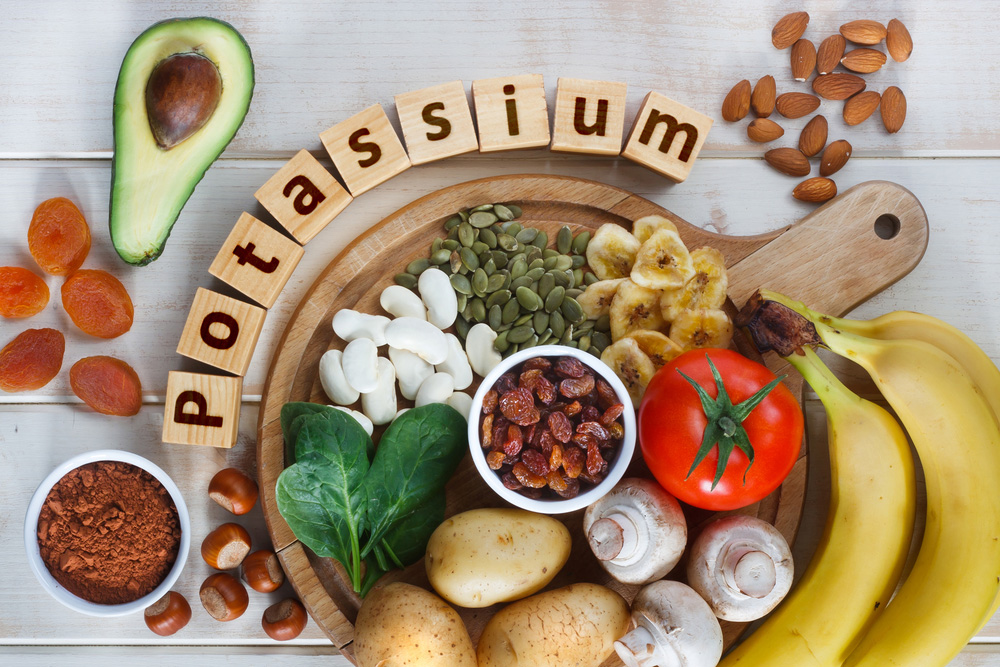
Most foods contain potassium, but the amount differs from food to food. The foods richest in potassium are mainly fruit and vegetables and dried fruit, as well as chocolate. It is also present in the juice of foods.
More specifically, cocoa powder (1,510 mg of potassium per 100 mg), dried apricots (100g worth 1,090 mg of potassium), dried figs (100g worth 900 mg of potassium), dried grapes (100g worth 773 mg of potassium), cooked chestnuts (100g worth 715 mg of potassium), etc. are rich in potassium.
There are also roast chicken, pistachio, dry sausage, swordfish, calf's liver, roast pork, bananas, cooked potatoes, cooked kidney beans, wheat pasta and blackcurrants.
What happens if there is a deficiency or excess of potassium?
Maintaining the right amount of potassium in the body is essential because a deficiency or overdose is dangerous for your health: in the most severe cases, it can lead to cardiac arrest.
Potassium deficiency: symptoms and dangers
You are deficient in potassium when you suffer from one or more of the following symptoms: you often have cramps, you have difficulty performing simple movements, your muscles are weak, your blood pressure rises alarmingly, and you have a cardiac arrhythmia.
It is rare for a healthy adult engaged in moderate physical activity to suffer from potassium deficiency. This is most often the case with digestive losses such as diarrhoea, vomiting, or in the case of endurance athletes, when there is a significant loss of sweat.
Potassium deficiency is extremely dangerous in that it can cause strokes or cardiac arrest: it can be fatal.
Excess potassium: causes and risks
Like potassium deficiency, excess potassium is often due to a malfunction in the body. Thus, this overdose is explained either by pathologies such as chronic renal disease or renal insufficiency, preventing the elimination of urine, or by the taking of diuretic drugs, which limit the quantity of potassium in the organic cells.
The risks related to potassium overdose are similar to the dangers related to a deficiency. Indeed, this results in fatigue, tremors or even numbness. The cardiovascular risks are just as important, and an excess of potassium is just as deadly as a deficiency in this mineral.
As an endurance athlete, you now know how important potassium is for your health. Never again be short of it, but don't overdo it either!