Silicium, with the chemical symbol "Si", is one of the trace elements found in the human body and in other plant foods. However, it does not belong to the category of so-called important elements. It is mainly a necessary element for the immune system in order to maintain good bone health, just like minerals.
Below are the important points to know about silicium
-
- First it is a metalloid of the carbon group. As seen above it is an essential trace element and very important for the body.
- It is mainly found in mineral water and plant foods but also in other foods but in small quantities.
- It helps the body to maintain calcium and to fight against bone demineralisation (the reduction of bone mineral mass or osteopenia).
- Organic silicium is useful for soothing various ailments mainly those associated with bones, joints and skin.
The importance of consuming silicium rich foods
The benefits of silicium to the body:
-
It maintains calcium
Silicium has an important function in calcium binding, it is mainly located at the osteoid (bone-like) edge where bone is formed.
- It contributes to immunity
There is a significant amount of silicium in the thymus (an organ in the upper chest), a fundamental organ of the immune system. It is also involved in the manufacture of antibodies.
- It prevents osteoarthritis (cartilage degradation)
For people with osteoarthritis, it should be noted that taking silicium as a supplement to a healthy, balanced diet can only have a positive effect on their bodies. This is because it contributes to the synthesis of glycosaminoglycans, which are found in abundance in cartilage and which promote its regeneration.
- It provides benefits to the hair
Organic silicium contributes to the structuring of connective tissue and phanera (apparent epidermal production such as skin, nails or hair. . . ). It is also a cyto-stimulant that strengthens the scalp, which means that it accelerates its renewal. Finally, silicium promotes the production of keratin and keeps the hair healthy.
Foods rich in silicium
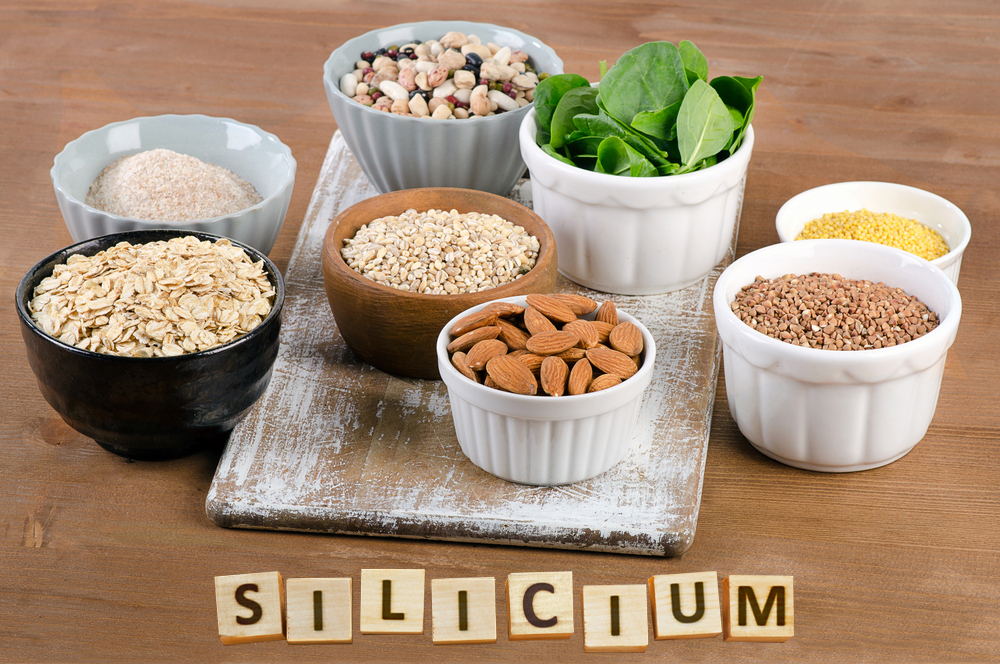
The ANSES (Agence nationale de sécurité sanitaire de l'alimentation, de l'environnement et du travail) table of nutritional composition of foods does not prove the precise quantities of silicium in foods. But here is a list of the 20 foods richest in silicium: those of vegetable origin such as wheat and oat bran, wholemeal wheat, barley, oats, spelt (a cereal close to wheat but dressed) wholemeal bread which is often present in the daily diet, legumes such as white beans, lentils, green beans, lettuce which are also often consumed and finally mushrooms, almonds, walnuts, various fruits (dates, apples, bananas) and another category which are drinking waters.
The negative effects of silicium
The consequences of silicium deficiency
To date, no research has concluded the outcome of silicium deficiency in an individual. However, one study was conducted on a rat and a mouse and showed a decrease in collagen and abnormalities in the bones in cases of silicium deficiency. It is important to know that the content of silicium does not decrease with the age of a person, on the contrary its distribution changes. For example, the amount of silicium in the skin, thymus and cartilage will decrease.
Side effects of silicium overdose
In case of overdose, the excess silicium is immediately eliminated by the kidneys, which means that there is no risk to the body except in the case of renal failure (kidney disease). According to the health agencies, silicium from food and drink has no harmful effect on health. For this reason, neither Efsa (European Food Safety Authority is one of the main agencies of the European Union) nor the IOM (Institute of Medicine of North America) has decided on any safety limit for silicium.
Interaction of silicium with aluminium
Silicium reduces the consumption and accumulation of aluminium. Thus, it can contribute to the prevention of some neurodegenerative pathologies (for example Alzheimer's disease or Parkinson's disease which are the most famous, but there are others) by decreasing the toxic side of aluminium on the cells of the nervous system.
It is also important to know that aluminium is the third most important element in the earth's crust after oxygen and silicium.