Pliometry is a training technique that is more common than you might think in sports exercise. We explain it in detail.
HISTORICAL REVIEW
This training technique first appeared in Soviet sports literature at the end of the 1960s, more precisely in 1966, when studies by the Russian researcher V. M. Zatsiorsky were published.
Russia, at that time the Soviet Union, was one of the dominant nations in many sports, along with the countries of the Eastern Bloc. While this is still somewhat the case today, it is important to understand that during this period, given the success of Russian athletes on the one hand, and the limited amount of information available and the mystery surrounding the secret arsenal of their training methods on the other, the slightest revelation was bound to arouse the greatest interest.
However, it was not until 1975 that an American track and field coach, Fred Wilt, proposed the term "plyometrics" to collect, classify and synthesise the main exercises known as plyometrics.
It must be admitted that the beginnings were rather disappointing. The effervescence created by the revelation of one of the secrets of the training of Russian athletes had as its first consequence an exaggerated, even sometimes exclusive, and certainly a little too hasty use of this technique. Trainers lacking scientific support therefore had some difficulty in dosing and integrating this innovation into their training programmes, which explains perfectly the cause of the first failures.
But gradually many studies* were carried out to finally bring clarity and provide the necessary explanations for the understanding and use of this method.
SCIENTIFIC REFERENCES
*Verkhoshansky - Russia, Komi - Finland, Schmidtbleicher - Germany, Margaria and Bosco - Italy, Wilson and Newton - Australia
**Neuromuscular spindles are located within muscle fibres. Their function is to react to muscle stretch by reflexively initiating a stronger contraction. It is the stretch reflex that allows us to react to, detect and control changes in fibre length.
SCIENCE AND PLYOMETRICS
The aim of plyometric exercises is to enable the muscle to reach maximum strength as quickly as possible
The principle of the method is based on the extension-shortening cycle. In other words, the muscle is first stretched by an eccentric contraction and then immediately shortened by a concentric contraction.
As we have just defined it, we understand that the particularity of this mode of contraction is the fact of passing as quickly as possible from the eccentric mode to the concentric mode. In exactly the same way as each of the other modes of contraction (anisometric, isometric, eccentric, concentric and isokinetic) have their own peculiarities.
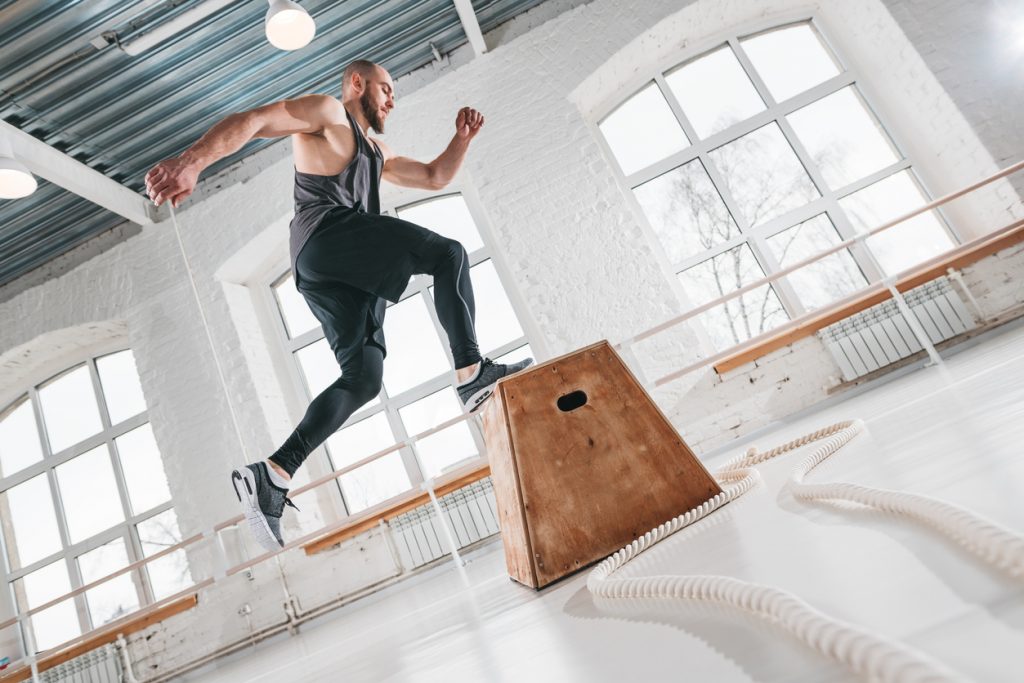
A good example is a deep jump followed by a rebound. Jumping from an elevated platform and producing a vertical rebound with minimal ground contact time between the landing phase (stretching, eccentric phase) and the vertical rebound phase (shortening, concentric phase) is a perfect example of this mode of contraction.
WHAT PHYSIOLOGY TELLS US
In the case of plyometrics, from the point of view of muscle physiology, two important factors must be taken into consideration:the stretch reflex and the elastic components of the muscle.
As mentioned, the concentric contraction of the muscle is immediately preceded by an eccentric contraction. This action will result in an accumulation of potential kinetic energy in the elastic components of the muscle, which will be released during the concentric contraction phase. The elastic elements thus act as energy accumulators.
On the other hand, the stretch reflex triggered by the neuromuscular spindles** increases the discharge of nerve impulses which in turn will activate a greater number of muscle fibres. The pre-innervation thus creates
thus creates an optimal innervation base for the muscular action that follows.
Andréa, MACS7® Physical Trainer, performs in this article a plyometric
session with multiple jumps. We have chosen three examples from the
series of exercises called multiple jumps.
COACH TIP:
- EXERCISE 1: 5 repetitions per set and recovery between each set to be able to produce maximum power at each repetition.
- EXERCISE N°2 : Facing the first band of the hexagon during each round.
- EXERCISE N°6 : Minimum impact on the ground between each hurdle.
EQUIPMENT USED :
- HEXAGON : EQUALIZER
- HEDGES ( 15CM AND 30CM)
- DECAMETER